
by admin
Share
by admin
Share
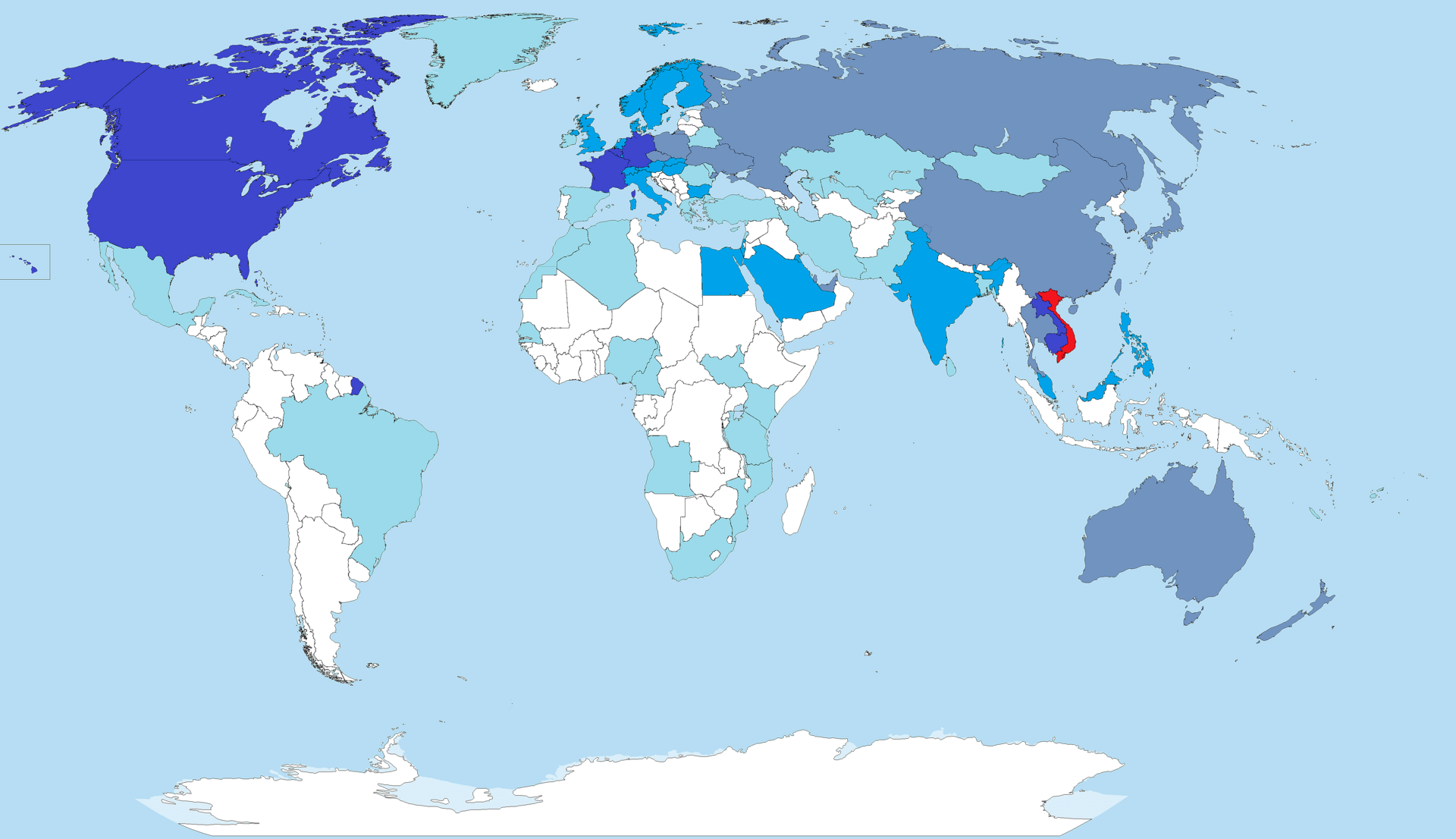
The Vietnamese diaspora (known in Vietnamese as Người Việt hải ngoại or Việt kiều) is one of the most widespread and dynamic diaspora communities in the world. Totalling an estimated 5.3 to 6 million people, the global Vietnamese population spans across North America, Europe, Australia, and neighboring Asian countries.
The diaspora’s evolution is a fascinating journey that shifted from historical refugee waves to a modern era of highly successful global citizens, students, and skilled professionals.
1. Global Distribution & Major Hubs
The Vietnamese diaspora is heavily concentrated in several key regions across the globe:
| Country | Estimated Population | Primary Hubs / Enclaves |
| United States | ~2.35 million | Orange County (Little Saigon), San Jose (CA), Houston (TX) |
| Japan | ~520,000 | Tokyo, Osaka (largely driven by technical trainees and students) |
| Cambodia | ~400,000 – 1M | Phnom Penh, Tonle Sap region (deep historical roots) |
| France | ~400,000 | Paris (13th Arrondissement), Lyon, Marseille |
| Australia | ~335,000 | Melbourne (Footscray), Sydney (Cabramatta) |
| South Korea | ~305,000 | Seoul, Busan (students, labor migrants, and marriage migrants) |
| Canada | ~275,000 | Toronto, Montreal, Vancouver |
| Taiwan | ~250,000 | Taipei, Taichung |
| Germany | ~226,000 | Berlin, Leipzig (historically split between East and West) |
2. The Three Great Historical Waves
The modern diaspora was largely shaped by three distinct historical phases:
-
Pre-1975 (The Intellectual & Colonial Wave): Early migration was concentrated in France during the colonial and post-colonial eras (following the 1954 Geneva Accords). This group consisted heavily of elites, royals, students, and professionals who assimilated smoothly into French society.
-
Post-1975 (The Refugee Wave): Following the Fall of Saigon and the end of the Vietnam War, hundreds of thousands of refugees—often referred to as “Boat People”—fled the country. Western countries like the US, Australia, Canada, France, and West Germany accepted massive influxes of refugees. Concurrently, North Vietnam sent thousands of contract workers and students to Soviet bloc countries like East Germany, Poland, the Czech Republic, and Russia.
-
21st Century (The Modern Economic & Academic Wave): Today, Vietnamese migration is entirely voluntary and highly competitive. It is characterized by international students attending top-tier universities, skilled professionals relocating for corporate tech/finance jobs, and labor migrants moving to manufacturing and service hubs in East Asia (Japan, South Korea, Taiwan).
3. Socio-Economic Status and Success
Across the West, the Vietnamese diaspora has transitioned from struggling first-generation refugees to one of the most socio-economically successful immigrant demographics.
-
Academic Excellence: Cultural values heavily prioritize education. Second and third-generation Vietnamese-Americans, Canadians, and Australians consistently achieve high rates of tertiary education degrees and are heavily represented in medicine, law, engineering, and tech.
-
Political and Cultural Representation: The diaspora has broken into mainstream global culture and politics.
-
In Culture: Renowned film directors like Trần Anh Hùng (France) and Ali Wong (half-Vietnamese, US), or world-famous chefs like Christine Hà (the blind MasterChef winner).
-
In Politics: Figures like Philipp Rösler (former Vice-Chancellor of Germany), and numerous politicians serving in the US Congress, Australian Parliament, and local mayoral seats (like Westminster, California).
-
4. Cultural Preservation and Hybrid Identity
Despite integrating thoroughly into their host nations, Việt kiều have retained a deep connection to their heritage, creating a unique hybrid identity:
-
Culinary Diplomacy: The diaspora has made Vietnamese food a global phenomenon. Phở and Bánh mì are household names worldwide, while unique diaspora adaptations—such as Viet-Cajun crawfish in Texas or Bo Bun in France—have become culinary staples in their own right.
-
The Concept of “Little Saigons”: In major Western cities, the diaspora established thriving commercial enclaves called “Little Saigons.” These hubs serve as economic engines and cultural sanctuaries where the Vietnamese language, media, and traditional holidays (especially Tết / Lunar New Year) are fiercely preserved.
-
Spiritual Ties: The late Zen Master Thích Nhất Hạnh established Plum Village in France, heavily influencing global mindfulness. Meanwhile, dedicated Vietnamese Buddhist temples and Catholic parishes span the globe, acting as community anchors.
5. The Changing Relationship with Vietnam
In the decades immediately following 1975, the relationship between the political diaspora and the Vietnamese government was fraught with tension. However, in the 21st century, the dynamic has evolved considerably.
Today, the diaspora is a cornerstone of Vietnam’s economic boom. Inbound remittances (kiều hối) from overseas Vietnamese total billions of dollars annually, accounting for a massive chunk of Vietnam’s GDP. Furthermore, a growing wave of “Returnee” (Reverse Migration) Việt kiều are moving back to Hanoi and Ho Chi Minh City to launch venture capitals, tech startups, and creative agencies, effectively bridging the gap between Vietnam and the global economy.
Would you like to focus on the history, culture, or economic impact of the Vietnamese diaspora in a specific country, such as the US, Australia, or Germany?
STAY IN THE LOOP
Subscribe to our free newsletter.
Leave A Comment
French is one of the world’s major international languages, widely used in business, diplomacy, education, tourism, and international cooperation. As communication between French-speaking countries and the rest of the world continues to create professional opportunities, skilled French interpreters play an important role in helping people communicate across language barriers. If you are passionate about languages

French and English are two widely used languages in international business, diplomacy, education, tourism, and global communication. As organizations continue to work across linguistic and cultural boundaries, the ability to communicate accurately between these languages remains valuable. For people who enjoy languages and cross-cultural communication, becoming a French and English interpreter can be a rewarding

English is one of the most widely used languages for international communication. As businesses, organizations, and individuals increasingly work across borders, the demand for professional English interpreters continues to grow. If you have strong English skills, enjoy communicating with people, and are interested in working in a multicultural environment, becoming an English interpreter can be

If you want to become a French interpreter, you’ll need more than just strong French—you need to develop professional interpreting skills, subject knowledge, and experience. A practical path Reach a high level in French Aim for C1–C2 French, especially listening and speaking. If you’re in Vietnam, the DELF/DALF can provide formal evidence of your French